
The Flagpole Vol. 11: Park Hill and the Problem with One Story
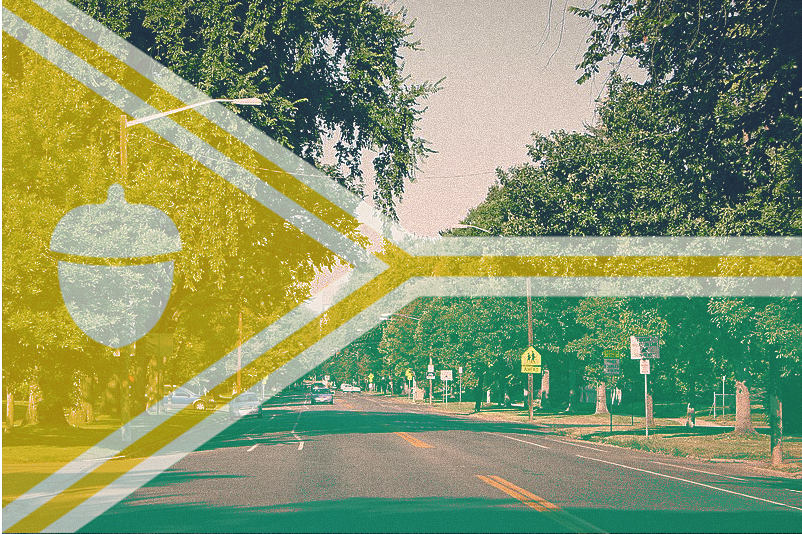
It’s been a bit but I am back again with the latest Flag of Denver. I have been working on this one for years at this point; just something that has been simmering in the background for a long time. Well all have those things that you give it attention when you can but it’s never the most important item on the list, so it inevitably falls by the wayside, and before you know it a few years have gone by. That is not to disrespect the neighborhood. There is no shortage of inspiration and stories to tell. That may actually be where the challenge lies…Park Hill has no one defining story.
In my 40-flag experience working on the Flags of Denver project, there is usually something that jumps off the page the moment I start sketching. A defining building (Phipps Mansion in Belcaro), an origin story (Athmar Park), an architectural style (Virginia Village), something you can’t ignore, or better yet, something that uncovers itself and then becomes impossible to ignore. Park Hill never did that. Every time I thought I had found the thread, I pulled it and found ten more attached to it.
Park Hill is a neighborhood with almost too many stories to tell. A Prussian baron who platted the whole thing in 1887 and preferred the company of Denver's dogcatcher to his neighbors. Dairy farms and brickyards that gave way to streetcar suburbs and then to one of Denver's most coveted addresses. A racially restrictive covenant that drew a hard line at Downing Street, and then the residents who organized to dismantle it, block by block. Rachel Noel, a Park Hill resident, who introduced a resolution to the Denver School Board in 1968 that eventually led to court-ordered desegregation of Denver's schools. An airport next door that the neighborhood fought to close. Chauncey Billups with "King of Park Hill" tattooed on his arm. And how do you choose just one? You can’t.
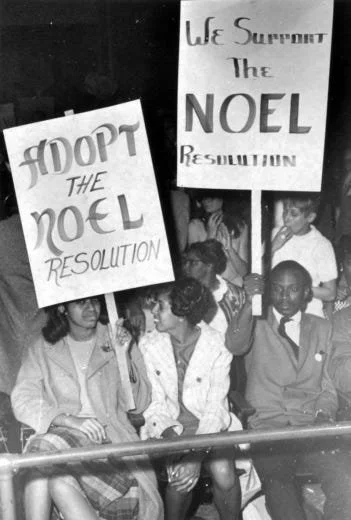
The Noel Resolution Resolution was for complete equality and integration in Denver Public Schools (Denver Public Library, Special Collections and Archives)
If you go all in on one story and center your design on it, you place too much weight on that one at the expense of everything else. In some neighborhoods that’s fine, sometimes a symbol means so much more than its literal definition (the windows of Union Station, the control tower at Central Park). But Park Hill is different. Its stories are small individually but together they tell an epic. On their own, none of them compose the full narrative arc of the neighborhood.
This is actually the central tension in a lot of design, and I kept coming back to it the longer I sat with this flag. City planning (my day job) has a long tradition of chasing the singular vision, the master plan, the big idea, the one thing that defines what a place is and what it wants to become. And sometimes that works. But most places that have actually been lived in, fought over, grown and contracted, populated by one group then another then another; they don’t have clean answers. Forcing one onto them doesn’t tell the story, it erases most of it.
The alternative is something closer to incremental urbanism, the idea that cities and neighborhoods aren't made by a single grand gesture but by small decisions layered over time, each one not particularly legible or even memorable on its own but composing something real in aggregate. Park Hill’s tree canopy is a good example. The city probably had street tree programs, parkway regulations, planting standards, there was a framework. But nobody sat down and drew the canopy that exists today. The framework set the boundaries, and then a thousand individual decisions got made within it over the last century. The result is one of the most distinctive physical characteristics of any neighborhood in Denver, and it didn’t come from a single vision or a single plan. It came from a framework that set the conditions and then mostly got out of the way and let the magic happen.
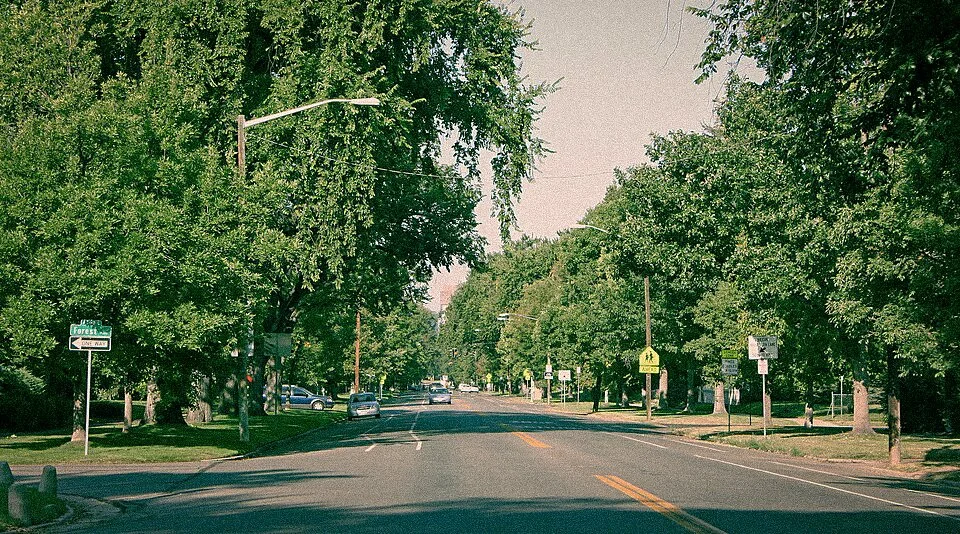
The canopy didn’t happen by accident. Mostly.
That’s what I kept coming back to with this flag. The answer wasn’t to pick one story. The answer was to find a symbol that could hold all of them. For me that is the acorn.
An acorn is literal, Park Hill’s canopy is legendary and those trees had to start somewhere. But my hope is that it does something more than that. The humble acorn represents potential. It's not the finished thing, it's the starting point. And one acorn doesn't just become one tree, it becomes part of the canopy. That felt like Park Hill, a neighborhood whose story is never really one story but always many, layered over a long time.

The Park Hill Neighborhood Flag (Flags of Denver)
The colors follow a similar logic. Blue for stability and home, green for the parks and the leafy streets, yellow for the warmth and energy of the community, white for the connections, rails and streets, that knit the neighborhood together. The chevron points the whole thing forward but also grounds it in the past.
This one took a few years but that felt appropriate in the end.
More soon.
—Steve
Explore all the Flags of Denver and learn the stories behind each design → View the collection